Palace Under the Blossoms
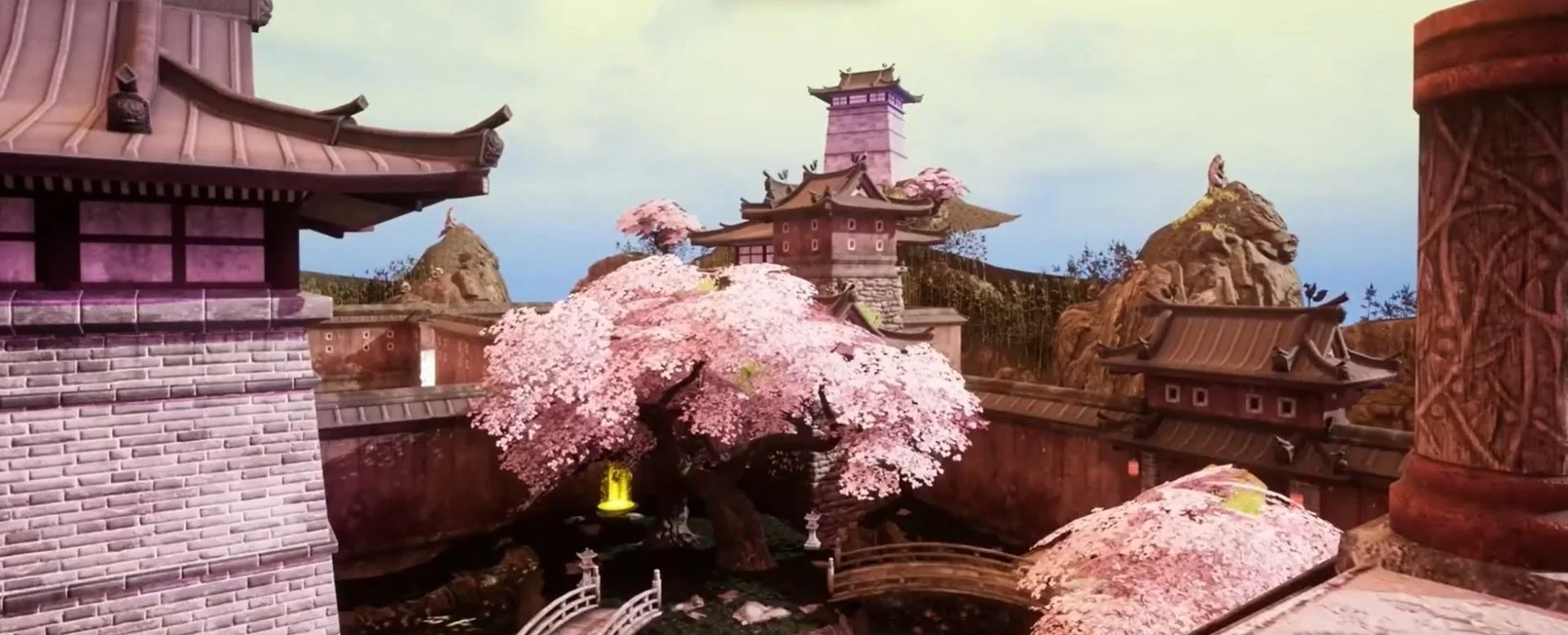
Built in Unreal Engine with the LYRA framework, ‘Palace Under the Blossoms’ demonstrates intentional level design, player flow, and environmental storytelling within a competitive control-point map set in a Japanese palace during Cherry Blossom season.
Level Design
Overview
For this project, I wanted to design a competitive control-point map set within the peaceful yet powerful atmosphere of a Japanese palace during Cherry Blossom season. Built in Unreal Engine using the Lyra framework, the goal was to create a space where intentional level design and immersive worldbuilding worked together to support fast, strategic gameplay. From the earliest sketches to the final lighting pass, every decision had to serve a clear purpose.
Designing Player Flow
I started with player flow, because if players can’t read the space or understand where to go, nothing else matters. Working from a top-down layout, I blocked out the palace grounds and began shaping how players would move between three distinct control points. I scaled player silhouettes for accurate proportions, mapped out team spawns, and placed each control point in a different style of space: one in a wide-open cherry blossom courtyard, one in a tighter corridor network, and one in a grand ceremonial hall. Each location pushes players into a different mindset and encourages different combat rhythms.
Route Planning & Navigation
With those anchors in place, I shifted my focus to building the routes that connect them. I wanted multiple approaches that rewarded different strategies: high-ground flanks, fast direct routes, and slower but safer paths tucked behind architecture. One of the most important additions became the “Golden Path,” the main route that naturally guides players across the map. It’s balanced and easy to read, but never restrictive. Alternative paths always remain viable, and players can choose how risky or aggressive they want to be. To help players orient themselves without breaking immersion, I added subtle environmental signage and architectural reads that gently nudge them in the right direction.
Spawn Design
Spawn design required just as much thought. I placed each team’s spawn far enough from major engagement zones to prevent camping, but not so far that players feel disconnected from the action. The distance is intentional: it keeps the pacing strong while maintaining fairness on both sides.
Architecture & Visual Intentionality
As I moved from layout to architecture, the palace took shape piece by piece inside Unreal. Every corridor bend, every courtyard angle, every piece of cover had a gameplay purpose. I constantly checked sightlines, adjusted traversal widths, and refined cover placement to maintain balance. Even small details such as a hanging lantern, a sloped roofline, or a stone barrier, were all placed with readability in mind.
To reinforce the setting, I focused heavily on the atmosphere. Ambient palace sounds, drifting cherry blossom petals, warm natural lighting, and traditional instrumental music helped transform the map from a simple playspace into somewhere memorable. Lyra’s built-in movement and combat systems gave me a strong foundation, letting me concentrate on what I care about most: intentional environment design that supports player experience.
Lessons in Detail & Readability
One thing this project taught me is how much small decisions stack up to create clarity. A slight shift in elevation can encourage players to push forward. A single decorative element can guide their eyes. Signage doesn’t need to scream to be understood. When all these pieces align, movement feels natural and the level becomes easy to learn without ever feeling hand-holdy.
In the end, “Palace Under the Blossoms” became more than a control-point map. It became a demonstration of how I approach level design: purposeful routes, readable spaces, architecture with intent, and atmosphere that elevates the experience. My goal with every project is to design worlds players don’t just move through, but remember; this map gave me a chance to fully express that philosophy inside Unreal Engine.
Post-Mortem & Future Improvements
Looking back on the project, there are a few things I would love to push further if I revisited this map.
The first is verticality. While the level offers multiple routes and strategic flanks, I feel there’s an opportunity to introduce more meaningful height variation, whether that’s elevated walkways, playable rooftops, or small elevation shifts that change how firefights unfold. Vertical play adds natural complexity and opens the door for more dynamic encounters, and I’d like to explore that more thoroughly.
The second thing I would refine is the use of default Unreal Engine placeholder text, especially on elements like health pads. Everything else in the environment is so intentional and thematic that seeing “HEALTH PICKUP” in UE’s default styling feels jarring. In the future, I would either create custom UI elements that fit the environment or replace the textual cues with intuitive visual language so players understand what they’re interacting with without any floating labels.
These are small things, but they matter, especially in a project that’s so focused on atmosphere, clarity, and intentional design.
Demo Video
Above is a video breaking down the design decisions I considered when creating this level. It highlights the flow, routes, spacing, and environmental cues in action, giving a deeper look at how all these ideas come together in gameplay.